This week I saw that the Science Fiction collection at the University of Liverpool has been awarded ‘Designated Status’ by Arts Council England. I’m very happy for them because visiting the archive was one of the highlights of my trip to Liverpool for the Current Research in Speculative Fiction conference earlier this year.
As autumn turns to winter it’s time for me to summarise what I’ve read and thought about fungi this season. I started off from the current trend for fungal fiction. I found myself asking whether fungi are being used to think about better ways of being, and this made me wonder about the relationship between fungi and utopia. This led me to think about the fungi appearing in contemporary utopian fiction, and to ask what work authors are putting fungi to in their literary utopias. Here’s what I found when exploring these questions.
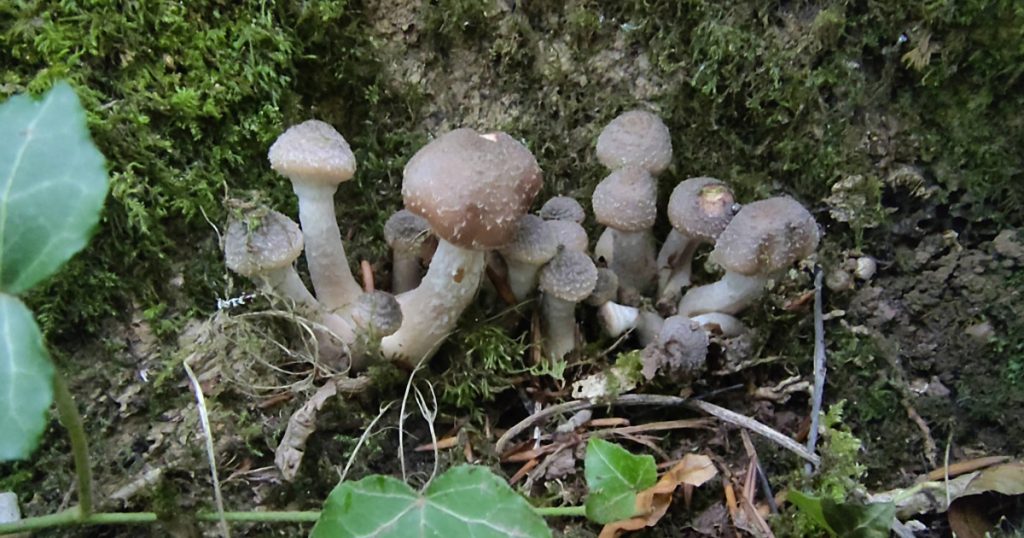
I’ve been reading a lot about fungal fiction and the fungal turn recently. It gets to a point where it’s weird to be inside reading about mushrooms when there are actual mushrooms outside. Accordingly, I’ve been fungi spotting whenever I’ve been out, and even going on mushroom walks specifically to look for them.
The CRSF annual conference took place on 3-4 July 2025. It was a hybrid event and I joined remotely. The official theme of the conference was ‘boundaries’. However, I felt there were two other themes that emerged from the event. Firstly the global prevalence of SF, which the hybrid format supported as it allowed for attendees from around the world. Secondly, fungal fiction, a current favourite topic of mine.
What’s the crossover between land work and utopia? I feel there is one, although it’s hard to articulate. Isn’t utopia science fiction, set in not-real places with fictional technology? How can that relate to working the land?
Well, increasingly utopian fiction is earthbound, with characters whose physical connection with the earth go beyond our own. Think the orogenes in N. K. Jemisin’s Broken Earth trilogy who manipulate seismic energy, and Vern in Rivers Solomon’s Sorrowland whose fungal “passenger” enables her to communicate through mycelial networks.
Then there is movement the other way, too. I recently visited the We Feed The UK exhibition across the Royal Photographic Society and Martin Parr Foundation galleries at Paintworks in Bristol. This project brought photographers and poets to farms across the UK who are growing agroecologically, eschewing intensive farming methods. Viewing the exhibition, it was clear to me the photographers and poets had seen hope in these places and were conveying this through their work.
What follows is my review of the exhibition, with a focus on the latent utopianism within its celebration of the “custodians of soil and sea”.
Let me take you behind the scenes on the video I recorded this morning for the upcoming Current Research in Speculative Fiction conference. It looks like this: a phone mount, attached to a GorillaPod, attached to some ivy, attached to a tree.
Last week, in the council chamber within the main building of Cardiff University surrounded by portraits of venerable white men, I attended a day long workshop on decolonial research led by Dr Leon Moosavi. As I embark on my PhD I am interested in what it takes to do the day job in a way that embodies the decolonial ideals of the utopian fictions I am studying, so that my research can work towards the same aim.
We went on a family trip to Cheddar Gorge and Caves and I was, like most visitors who have been in the show caves over the past 187 years I’m sure, very impressed by the rock formations. What I was particularly impressed by was their semblance to other things in nature I would usually think of as alive.
I know, and knew before I stepped inside the caves, that over a long enough timescale rock is dynamic. In terms of visualising this, I would have thought of lava, or rocks being eroded over time, or even water dripping over rock to form stalactites and stalagmites. But seeing the organic forms of the rocks within the caves made me think more about rock as a living thing.
Contains information related to marketing campaigns of the user. These are shared with Google AdWords / Google Ads when the Google Ads and Google Analytics accounts are linked together.
90 days
__utma
ID used to identify users and sessions
2 years after last activity
__utmt
Used to monitor number of Google Analytics server requests
10 minutes
__utmb
Used to distinguish new sessions and visits. This cookie is set when the GA.js javascript library is loaded and there is no existing __utmb cookie. The cookie is updated every time data is sent to the Google Analytics server.
30 minutes after last activity
__utmc
Used only with old Urchin versions of Google Analytics and not with GA.js. Was used to distinguish between new sessions and visits at the end of a session.
End of session (browser)
__utmz
Contains information about the traffic source or campaign that directed user to the website. The cookie is set when the GA.js javascript is loaded and updated when data is sent to the Google Anaytics server
6 months after last activity
__utmv
Contains custom information set by the web developer via the _setCustomVar method in Google Analytics. This cookie is updated every time new data is sent to the Google Analytics server.
2 years after last activity
__utmx
Used to determine whether a user is included in an A / B or Multivariate test.
18 months
_ga
ID used to identify users
2 years
_gali
Used by Google Analytics to determine which links on a page are being clicked
30 seconds
_ga_
ID used to identify users
2 years
_gid
ID used to identify users for 24 hours after last activity
24 hours
_gat
Used to monitor number of Google Analytics server requests when using Google Tag Manager